SECURE AMERICA NOW

Secure America Now is a community of over 4 million patriots dedicated to defending American security, values, and freedoms. Through bold advocacy and grassroots action, we hold leaders accountable and fight for a safer, stronger nation.

Thank you for joining the movement to Secure America Now!
Oops! Something went wrong while submitting the form.

OUR PRIORITIES

EXPOSE THE SILENT JIHAD

Secure America Now's mission is to bring critical national security threats to the forefront of the American debate.

Item 1

Defeating Ideological Infiltration of the West

Item 2

Exposing Foreign Influence in American Institutions

Item 3

Defending National Sovereignty from Sharia-Based Policy

Learn more

SECURE AMERICA NOW OFFICIAL STORE

Every piece of merch bought from the official SAN store fuels our critical mission to protect our homeland and preserve common-sense national security. When you wear Secure America Now gear, you aren't just making a statement; you are joining a frontline movement of thousands of Americans demanding we maintain borders, put an end to sanctuary cities, and take a clear, unyielding stance against foreign nuclear threats.

SECURE OUR FUTURE TOGETHER - Enter Store Here

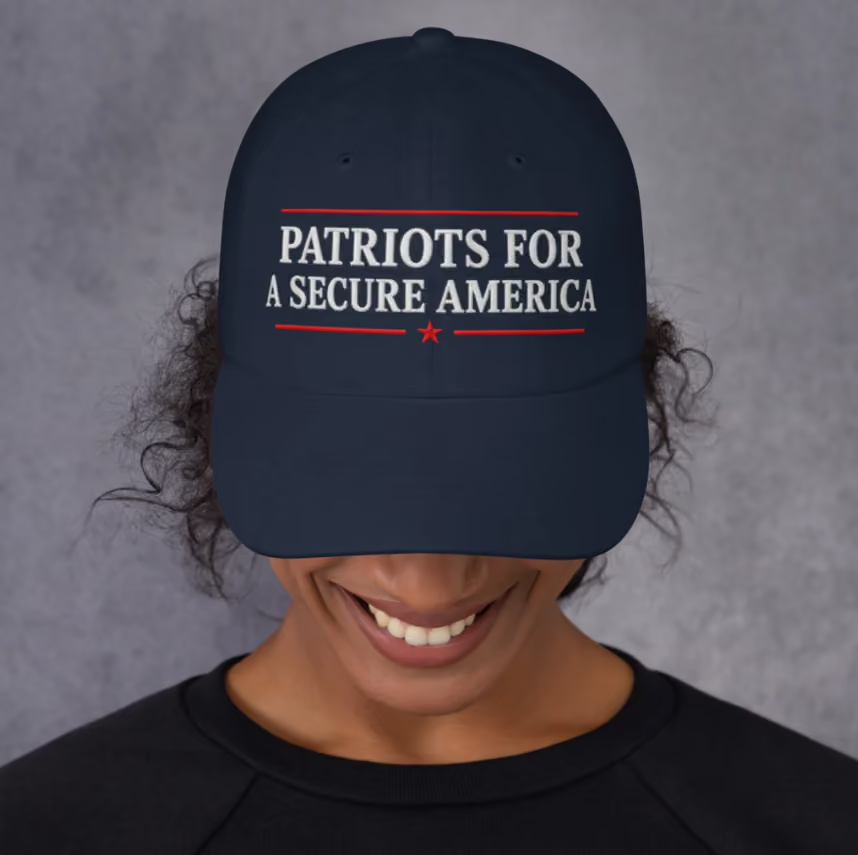
Dad hat

$15.50
BUY NOW

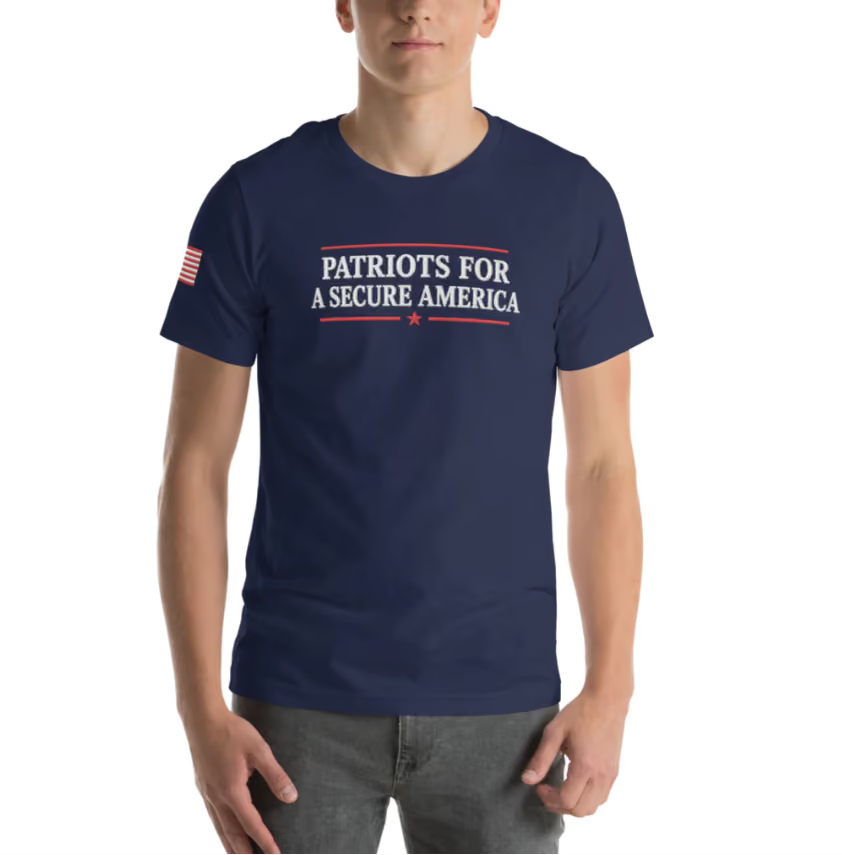
Unisex t-shirt

$22.50 - $31.00
BUY NOW

listen to the code red podcast

Stay informed on national security with expert analysis and
hard-hitting discussions on the Code Red Podcast.

Stylized text 'CADE RED' with a red triangle and radiation symbol replacing the letter A on black background.
code red podcast

On Code Red, Secure America Now’s President, Allen Roth, talks to experts about critical national security threats and their impact on America’s safety.

Spotify logo with text ‘Listen On’ on red background.
Button saying 'LISTEN ON' with Amazon Music logo on red background.
Red button with white text 'LISTEN ON' and a white podcast or radio icon.
Red button with white text 'LISTEN ON' and YouTube play icon.
Trump Administration Cracks Down on Sanctuary Cities | Trump Administration Removes Record Numbers of Criminal Aliens | President Trump Demands Total Dismantlement of Iran’s Nuclear Program, Pressures Tehran With Maximum Pressure Campaign | Trump Administration Rallies International Support to Prevent Iran From Obtaining Nuclear Weapons | Trump Administration Cracks Down on Sanctuary Cities | Trump Administration Removes Record Numbers of Criminal Aliens | President Trump Demands Total Dismantlement of Iran’s Nuclear Program, Pressures Tehran With Maximum Pressure Campaign | Trump Administration Rallies International Support to Prevent Iran From Obtaining Nuclear Weapons |

SAN war room

September 15, 2026

Does New York cooperate with ICE? What did Governor Kathy Hochul change about immigration enforcement in New York?

In 2026, New York Governor Kathy Hochul signed the Local Cops, Local Crimes Act, a law that restricts state and local participation in federal civil immigration enforcement and prohibits New York law-enforcement agencies from participating in ICE's 287(g) program.

The law does not prohibit all cooperation between New York law enforcement and federal authorities. Criminal investigations remain distinct from federal civil immigration enforcement.

Here are five major ways Hochul's immigration policies limit state and local cooperation with U.S. Immigration and Customs Enforcement (ICE).

1. Hochul Banned New York’s 287(g) Agreements With ICE

On May 27, 2026, Hochul signed the Local Cops, Local Crimes Act.

The law prohibits New York local governments and law-enforcement agencies from entering or remaining in agreements with ICE under Section 287(g) of the Immigration and Nationality Act.

ICE's 287(g) program allows participating state and local officers to receive training and authorization to perform specified federal immigration-enforcement functions under ICE supervision.

New York's law effectively removed that option for local law-enforcement agencies across the state.

2. New York Ordered 12 Law-Enforcement Agencies to End Their ICE Agreements

When New York implemented the new restrictions, 12 local law-enforcement agencies had active 287(g) agreements with ICE.

The New York Attorney General's Office notified those agencies that state law required them to unwind their agreements by August 25, 2026.

That meant counties that previously chose to participate in ICE's immigration-enforcement program could no longer maintain those agreements under New York law.

3. New York Restricted Local Jails From Supporting Federal Civil Immigration Detention

Hochul's immigration policy goes beyond the 287(g) program.

The Local Cops, Local Crimes Act also prohibits local governments and law-enforcement agencies from entering certain arrangements that use local resources or facilities to detain individuals solely for federal civil immigration violations.

This distinction is important.

The law does not prohibit New York police from working with federal authorities on criminal investigations. Instead, it specifically limits state and local participation in civil immigration enforcement.

4. Hochul Helped Create the Office of Immigrant Trust

New York also established the Office of Immigrant Trust (OIT) within the New York Attorney General's Office.

The office is responsible for enforcing state laws that limit state and local involvement in federal civil immigration enforcement.

Its authority includes investigating potential violations, reviewing records, interviewing witnesses, issuing subpoenas and bringing civil actions when warranted.

The office also oversees compliance with restrictions involving 287(g) agreements, state and local resources, sensitive information and other immigration-enforcement activities.

5. Hochul and Letitia James Sued a Sheriff Over Continued ICE Cooperation

New York has also gone to court to enforce its 287(g) ban.

On August 27, 2026, Attorney General Letitia James and Governor Hochul announced a lawsuit against the Rensselaer County Sheriff's Office after the office did not confirm that it had terminated its 287(g) agreement with ICE by the state's August 25 deadline.

According to the Attorney General's Office, Rensselaer County was the only one of the 12 agencies that had not indicated an intention to dissolve its agreement by that point.

The lawsuit asks a court to compel the Sheriff's Office to terminate the agreement and declare it void and unenforceable under New York law.

What Is Kathy Hochul’s Policy on ICE and Immigration Enforcement?

Hochul's current policy restricts the extent to which New York state and local government resources can be used for federal civil immigration enforcement.

Under the policies enacted in 2026:

  • New York law-enforcement agencies cannot participate in ICE's 287(g) program.
  • Existing 287(g) agreements were required to be terminated.
  • State and local resources face restrictions on their use for civil immigration enforcement.
  • Certain agreements involving detention solely for federal civil immigration violations are prohibited.
  • The Office of Immigrant Trust oversees compliance with these state restrictions.
  • New York has taken legal action to enforce the 287(g) ban.

These policies do not prohibit every form of cooperation between New York and federal law enforcement. Hochul's administration has explicitly distinguished criminal investigations from civil immigration enforcement.

Is New York a Sanctuary State?

There is no single federal legal definition of a “sanctuary state.”

The term is commonly used in political and policy debates to describe jurisdictions that restrict how state or local resources can be used for federal immigration enforcement.

New York's 2026 laws establish several such restrictions, including its prohibition on local 287(g) agreements and limitations on the use of local resources for federal civil immigration enforcement.

For legal accuracy, the more precise description is that New York limits state and local participation in federal civil immigration enforcement.

Frequently Asked Questions About Kathy Hochul, ICE and New York Immigration Policy

Does New York cooperate with ICE?

Yes, in some circumstances. New York's 2026 restrictions primarily concern federal civil immigration enforcement. They do not prohibit cooperation with federal law enforcement in criminal investigations.

Did Kathy Hochul ban 287(g) agreements in New York?

Yes. Hochul signed the Local Cops, Local Crimes Act on May 27, 2026. The law prohibits New York local governments and law-enforcement agencies from entering or remaining in 287(g) agreements with ICE.

What is an ICE 287(g) agreement?

Section 287(g) of the Immigration and Nationality Act allows ICE to enter agreements with state and local law-enforcement agencies. Participating officers can receive training and authorization to perform specified immigration-enforcement functions under ICE supervision.

How many New York law-enforcement agencies had 287(g) agreements?

According to the New York Attorney General's Office, 12 local law-enforcement agencies had 287(g) agreements when the state began enforcing its new prohibition in 2026.

When did New York's 287(g) agreements have to end?

New York required existing agencies to exercise their termination provisions by August 25, 2026.

What is New York's Office of Immigrant Trust?

The Office of Immigrant Trust is a bureau within the New York Attorney General's Office created to enforce state civil laws involving immigrant communities and restrictions on state and local participation in federal civil immigration enforcement.

Did New York sue a sheriff over an ICE agreement?

Yes. On August 27, 2026, New York Attorney General Letitia James and Governor Kathy Hochul announced a lawsuit against the Rensselaer County Sheriff's Office over its 287(g) agreement with ICE.

Does the Local Cops, Local Crimes Act stop police from working with federal authorities on criminal cases?

No. The Hochul administration has stated that the law does not prohibit state or local law enforcement from continuing to cooperate with federal law enforcement in criminal investigations.

What Does the Local Cops, Local Crimes Act Mean for New York?

The Local Cops, Local Crimes Act represents a significant change in how New York participates in federal immigration enforcement.

Rather than allowing individual counties and law-enforcement agencies to decide whether to participate in ICE's 287(g) program, New York state law now prohibits those agreements statewide.

The result is a clear statewide policy: local law-enforcement resources can still be used for policing and criminal investigations, while their use for federal civil immigration enforcement is substantially restricted.

Read Article

September 7, 2026

Labor Day honors the hardworking Americans whose sacrifice and determination keep our country running.

From construction sites and factories to farms, hospitals, police departments, and military installations, American workers build our communities, protect our families, and strengthen our nation every day.

They deserve a government that works just as hard to protect them.

What Does National Security Have to Do With Labor Day?

National security directly affects the Americans who work, raise families, and build communities across the country.

Working Americans depend on secure borders, enforced laws, safe neighborhoods, strong institutions, and a dependable national defense. This Labor Day, Secure America Now is calling for policies that protect the people who keep our country strong.

SIGN THE PETITION AND STAND WITH AMERICAN WORKERS

American Workers Deserve Secure Borders

Border security is a national security and public safety responsibility.

The federal government must secure the border, enforce immigration laws, and properly screen those entering the United States. Local and federal authorities should also work together to keep dangerous individuals out of American communities.

American workers should not have to bear the consequences of illegal immigration and sanctuary policies. They deserve secure borders, lawful immigration, and leaders committed to public safety.

Safe Communities Require Strong Law Enforcement

Law enforcement officers, firefighters, first responders, and service members work every day to protect the American people. Many of them spend Labor Day on duty while others spend time with their families.

Their service and sacrifice must never be taken for granted.

Supporting law enforcement means giving officers and agencies the resources, cooperation, and policies they need to protect our communities.

America Must Confront National Security Threats

Protecting American families also requires confronting radical Islamist extremism and preventing extremist networks from influencing the institutions that shape our laws, communities, and national security.

This effort must remain focused on extremists and organizations that promote violence, support terrorism, or threaten the United States.

America must also hold Iran’s regime accountable and prevent it from threatening Americans and our allies. Peace through strength requires clear priorities, credible deterrence, and leaders who put American security first.

What Do American Workers Deserve?

American workers deserve:

  • Secure borders and enforced immigration laws
  • Safe communities supported by law enforcement
  • Protection from radical Islamist extremism
  • Accountability for Iran and terrorist organizations
  • A government committed to defending the American people

SIGN THE PETITION AND STAND WITH AMERICAN WORKERS

American workers built this country through sacrifice, determination, and hard work. They deserve more than words of appreciation. They deserve leaders who will defend them.

This Labor Day, Secure America Now stands for secure borders, safe communities, strong law enforcement, and peace through strength.

Stand with Secure America Now and help us keep America safe.

Read article

September 4, 2026

Conservative political creators are no longer operating at the edge of the news business. They are becoming one of its main entry points.

Instead of waiting for a television segment, newspaper column, or network correspondent, millions of Americans now encounter political news through street interviews, podcast exchanges, reaction videos, confrontations, and short clips selected by an algorithm. The creator is often the reporter, host, editor, analyst, and distributor at the same time.

For Secure America Now, this shift has major strategic consequences. Stories involving illegal immigration, violent crime, Iran, radical Islam, Israel, and threats to American institutions are increasingly being introduced to younger audiences by conservative personalities. These creators are reaching Americans with stories and arguments that establishment gatekeepers often downplay, sanitize, frame differently, or never put in front of younger audiences.

The numbers demonstrate how significant the shift has become. Pew Research Center reported in December 2025 that 38% of Americans under 30 regularly get news from news influencers. The Reuters Institute reported in 2026 that young people using social and video platforms pay more attention to individual news creators than traditional news brands, 51% compared with 39%.

The reason is straightforward: creators deliver information in the formats younger Americans already watch.

Quick answer: How are creators bypassing traditional news?

Conservative creators bypass traditional news by publishing directly to audiences on YouTube, X, Instagram, TikTok, Rumble, and other digital platforms.

Their advantage comes from speed, recognizable personalities, direct audience relationships, and platform-native formats that combine information with entertainment. Some conduct original reporting. Others provide analysis, argument, satire, or cultural commentary.

The most effective creators understand that audiences are not simply looking for facts. They are looking for someone who can show them why those facts matter.

Here are five ways the new political media is changing how Americans encounter national-security and cultural issues.

1. Nick Shirley takes political reporting directly to the scene

Traditional reporting usually places a correspondent between the audience and the event. Street creators remove much of that distance.

Nick Shirley has built a recognizable style around arriving at politically charged locations, approaching people directly, and asking questions on camera. In the clip featured in this package, Shirley visits a Texas mosque while investigating questions surrounding EPIC City. After he says he is not Muslim, he is told that he cannot remain in part of the mosque.

Whether viewers agree with Shirley’s conclusions or not, the format is powerful because the audience watches the encounter unfold. There is no studio desk and little institutional mediation. The tension comes from uncertainty. The creator does not know exactly what the next person will say or how the interaction will end.

That makes street reporting especially effective for issues involving immigration, protests, campus politics, public safety, religious influence, and threats to American institutions. Questions that might otherwise remain abstract become visible and immediate.

Why it works: Shirley places viewers inside an encounter that traditional media might reduce to a headline, brief quotation, or carefully edited segment.

2. Steven Crowder turns policy comparisons into visual arguments

Government data rarely arrives in a compelling form. Agency reports, tables, and enforcement statistics may contain important information, but they are not naturally designed for social feeds.

Steven Crowder turns those materials into direct visual arguments. In the immigration clip included in this package, Crowder uses headlines, enforcement statistics, and side-by-side comparisons to challenge the claim that there is no meaningful difference between the Trump and Biden administrations.

The format does more than cite numbers. It gives those numbers a narrative. One approach emphasizes border enforcement, while the other is presented as weakening America’s ability to control illegal immigration.

For national-security organizations, the lesson is important. Statistics about border encounters, removals, visa enforcement, terrorism, sanctions, and criminal arrests become more memorable when they are organized around a clear and consequential choice.

Why it works: Crowder transforms scattered policy information into a contrast that viewers can understand and share within seconds.

3. Matt Walsh turns an overlooked crime story into a demand for accountability

Creators do not only react to stories after they become national news. They can also direct public attention toward cases that institutions and major news organizations have failed to pursue with sufficient urgency.

In the clip featured here, Matt Walsh recounts his coverage of Ronald Exantus, a violent offender who was released on parole and found living next to an elementary school in Florida. Walsh says his reporting brought additional attention to the case and prompted closer scrutiny from state officials.

Florida authorities subsequently placed Exantus under surveillance and arrested him for failing to register as a convicted felon.

The clip works because it gives audiences more than commentary. It shows how a creator can elevate a local public-safety failure, generate national attention, and pressure authorities to act.

For SAN, this is the kind of creator content that connects directly to law and order. It exposes what can happen when dangerous offenders are returned to American communities without sufficient accountability or oversight.

Why it works: Walsh turns an overlooked case into a clear argument about violent crime, government responsibility, and the protection of American children.

4. Patrick Bet-David turns long-form conversations into viral national-security questions

Podcasting has created another route around the traditional newsroom. Instead of compressing an argument into a short television segment, hosts can explore it through a longer conversation and distribute the strongest moments as individual clips.

Patrick Bet-David’s discussion of the Islamic call to prayer in Times Square demonstrates that approach. He asks whether countries such as Iran or Yemen would permit thousands of Christians to worship with the same visibility and freedom.

The question transforms a complicated discussion about religious liberty, reciprocity, cultural confidence, and hostile regimes into a challenge viewers can immediately understand and debate.

For SAN, the issue extends beyond one public religious display. America’s commitment to religious liberty should not prevent its leaders from confronting radicalization, foreign ideological influence, the persecution of Christians, or movements that reject the freedoms protecting them.

A long podcast can provide context, while a short clip can introduce the argument to millions of viewers who may never watch the entire episode.

Why it works: Bet-David uses a pointed question to connect an American cultural moment with a larger debate about freedom, reciprocity, and national security.

5. Ben Shapiro exposes the meaning behind political symbolism

Political communication is not limited to legislation and official statements. Images, gestures, clothing, and public appearances can carry political meaning of their own.

Ben Shapiro’s commentary on New York Governor Kathy Hochul wearing a headscarf at an Islamic center focuses on that symbolic dimension. Shapiro contrasts Hochul’s appearance with the reality that women living under some Islamist regimes face legal or social coercion over how they dress.

The argument is not simply about a garment. It is about what American leaders choose to celebrate and what they choose to ignore.

When political officials embrace religious symbolism for a public appearance while saying little about women resisting coercion under Islamist regimes, creators can expose the contradiction in a way that conventional coverage may avoid.

For SAN, the stakes are larger than one appearance. American leaders must be willing to distinguish religious freedom from political accommodation and confront radical Islamist influence without sanitizing its treatment of women, its hostility toward Western values, or its threats to American institutions.

The August 2026 appearance generated national attention partly because conservative commentators challenged the political symbolism behind the event rather than treating it as an ordinary ceremonial visit.

Why it works: Shapiro connects a single image to a larger argument about political accommodation, women’s freedom, Islamist coercion, and cultural double standards.

Why creator-led political media reaches younger audiences

The success of these creators is not simply the result of ideology. Their formats match how younger audiences use digital platforms.

Personality creates familiarity

Traditional outlets ask audiences to trust an institution. Creator media asks audiences to trust, or at least recognize, an individual.

A recurring voice, face, style, sense of humor, and worldview creates familiarity across hundreds of videos. Viewers begin to understand how a creator approaches an issue before the clip even begins.

Video makes serious issues easier to enter

A viewer does not need to begin by searching for a policy report or government document. A compelling scene, question, contradiction, or confrontation can introduce the issue first.

Once attention has been earned, facts and context can follow.

Algorithms reward strong moments

Younger users frequently encounter political news without deliberately searching for it. Pew’s 2025 research found that among adults under 50 who regularly get news from influencers, 72% said they mostly happen to come across that content.

In this environment, the opening seconds matter enormously. A strong hook can determine whether a national-security argument reaches thousands of people or disappears into the feed.

Commentary supplies meaning

Creators rarely pretend to be detached. They tell viewers what they believe an event means and why it should matter.

That clarity can attract supporters and critics alike. Both groups can generate comments, shares, responses, and further distribution.

Every long video can become multiple pieces of content

Podcasts, livestreams, debates, and field reports provide a steady supply of clips. One recording can become a vertical video, quote card, X post, Facebook card, email hook, and longer article.

This allows organizations to test different messages and formats without abandoning their central mission.

Why verification still matters

The rise of creator-led news does not eliminate the need for verification. It increases it.

Speed and personality help content travel, but they can also strip away important context. A clip may be authentic while still presenting an incomplete picture.

Responsible creator media should follow several basic standards:

  • Link to the original video or primary document.
  • Identify when and where the event occurred.
  • Separate confirmed facts from commentary or inference.
  • Avoid editing a clip in a way that changes its meaning.
  • Clearly identify the creator being featured.
  • Correct errors when credible new information emerges.

These standards are particularly important when discussing immigration, terrorism, religious extremism, Iran, Israel, and national security. The subjects are serious, facts can change quickly, and a misleading claim can weaken an otherwise persuasive argument.

What the new political media means for Secure America Now

Secure America Now does not need to change its core national-security priorities. It needs to deliver them through the forms of political media that younger Americans already consume.

That means pairing SAN’s focus on secure borders, terrorism, radical Islamist movements, Iran, Israel, law and order, and American sovereignty with creator-led formats that earn attention.

Those formats include:

  • Street reporting that brings viewers directly to the scene.
  • Visual comparisons that make policy consequences understandable.
  • Commentary that exposes contradictions and institutional failures.
  • Podcast exchanges built around provocative questions.
  • Cultural analysis that reveals the meaning behind political symbolism.
  • Short videos that turn complex threats into clear stakes.

The creator should not replace SAN’s message. The creator should open the door to it.

Every clip must still be selected for relevance, factual accuracy, and strategic value. Virality alone is not enough. The content must connect naturally to SAN’s mission and introduce younger audiences to issues affecting American sovereignty, security, and freedom.

The bottom line

Conservative creators are not waiting for permission from traditional news organizations. They are building their own distribution systems, setting their own agendas, and speaking directly to audiences that legacy outlets increasingly struggle to reach.

Nick Shirley brings viewers into the encounter. Steven Crowder turns policy data into contrast. Matt Walsh elevates an overlooked public-safety failure. Patrick Bet-David turns long conversations into viral national-security questions. Ben Shapiro interprets the political symbolism behind the headline.

Their styles differ, but the underlying shift is the same. Political information now competes in the same feeds as entertainment, sports, humor, and culture.

If younger Americans increasingly understand politics through creators, national-security organizations cannot surrender those feeds.

Secure America Now must meet them there with content that earns attention, exposes threats, challenges sanitized narratives, and makes the stakes for America impossible to ignore.

Frequently asked questions

What is a political content creator?

A political content creator is a personality who produces reporting, analysis, interviews, commentary, or satire primarily for digital platforms rather than through a traditional news organization.

How are political creators bypassing traditional news?

They publish directly to audiences through social platforms, allowing them to report, analyze, edit, and distribute content without relying on television networks, newspapers, or institutional gatekeepers.

Why are younger Americans getting political news from creators?

Creator content is visual, direct, personality-driven, and easy to encounter on social platforms. Younger audiences often discover political information in their normal feeds instead of intentionally visiting a news website.

Are political creators replacing traditional journalism?

Creators are increasingly replacing traditional outlets as the first point of contact with a story. However, primary documents, credible reporting, verification, and on-the-ground newsgathering remain essential.

Which creator formats work well for national-security content?

Street interviews, podcast clips, debates, confrontations, reaction videos, campus interactions, cultural commentary, satire, and concise policy comparisons are especially compatible with social platforms.

Which national-security topics fit creator-led media?

Border security, illegal immigration, sanctuary policies, violent crime, terrorism, Iran, Israel, radical Islamist movements, religious persecution, and threats to American institutions can all be presented effectively through creator-led formats.

How should organizations use creator content responsibly?

Organizations should select clips for relevance, preserve context, document the original source, verify factual claims, identify the featured creator, and distinguish clearly between confirmed reporting and opinion.

Read Article

secure America now: Projects

Uncovering the Truth on Top
National Security Issues